COMMERCIAL KITCHEN KNOWLEDGE BASE // INSIGHTS & BLUEPRINTS
Data-Driven Blueprints for the Modern Food Venture
Practical unit economics, aggregator algorithmic strategy, AutoCAD operational layouts, and gram-level recipe standardization guides by CloudurKitchen.
Unit Economics
By Sukhmanpreet SinghMarch 18, 20266 min read
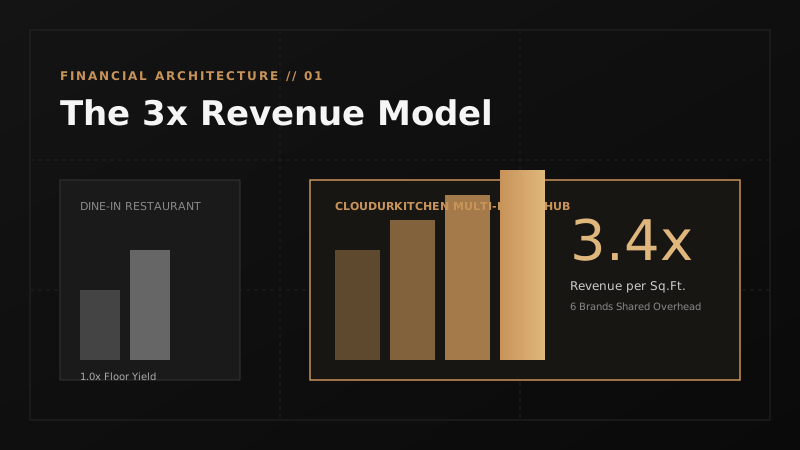
Cloud Kitchen Economics: How to Achieve 3× Revenue per Square Foot
Traditional sit-down restaurants allocate 70% of high-street floor space to non-revenue producing customer seating. Here is the operational blueprint showing how multi-brand commercial kitchens invert this equation to maximize revenue per square foot.
The Structural Flaw of Traditional Brick-and-Mortar
A standard 1,200 sq.ft. sit-down restaurant dedicates nearly 800 sq.ft. to dining furniture, hostess stands, customer waiting areas, and restrooms. During off-peak hours (between 2:30 PM and 6:30 PM), that prime real estate sits idle while high-street rent, commercial air conditioning, and municipal property taxes tick without interruption.
1. The 3× Asset Utilization Paradigm
By operating 4 to 6 specialized virtual culinary concepts from a single 350 sq.ft. commercial kitchen production cluster, your heavy-duty capital equipment works around the clock:
Mid-Afternoon Dip (3:30 PM – 6:00 PM): Fries, snacks, beverages, and cold dessert brands take over the delivery ticker.
Dinner Peak (7:00 PM – 11:30 PM): Slow-cooked biryani, Mughlai curries, and family-sized fried chicken buckets maximize average order value.
"In a multi-brand cloud kitchen, square footage is not measured by chair count, but by prep capacity, shared cold-chain efficiency, and packaging turnaround velocity."
2. Defending Gross Margins Against Aggregator Cut
While delivery aggregators charge commissions between 18% and 25%, a lean delivery hub eliminates 15% front-of-house payroll, 12% prime high-street rent premiums, and substantial utility losses. The result is net margins exceeding 18% to 22% once monthly order volume scales beyond 3,500 units.
Platform Growth
By Practice Intelligence UnitMarch 10, 20268 min read
Cracking the Delivery Platform Algorithms in 2026: Swiggy, Zomato & Talabat
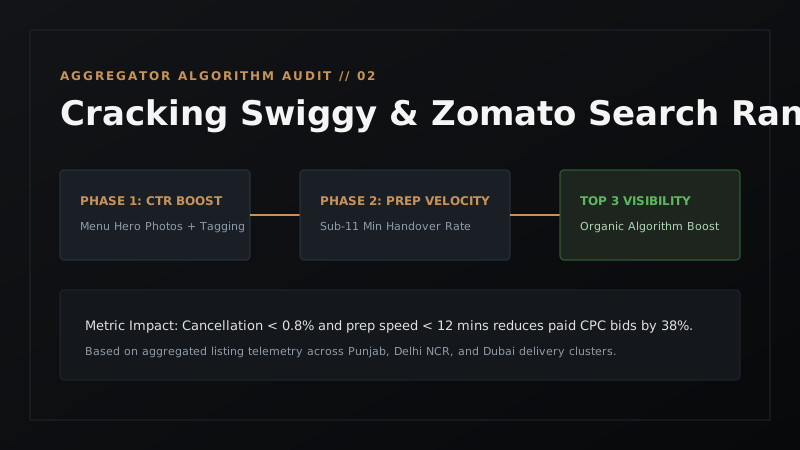
Relying on unsustainable discount burning and high CPC ad bids erodes gross margins. Discover how rider prep time, order completion velocity, and visual CTR systematically influence platform search rankings.
The Illusion of Paid Advertising Superiority
Many restaurant owners assume that pouring ₹30,000 to ₹50,000 per month into aggregator CPC bids guarantees profitability. In reality, platform search algorithms prioritize organic kitchen operational reliability over raw bid amounts.
1. The Core Algorithmic Drivers
Kitchen Prep Velocity (KPV): Maintaining an average order ready time under 11 minutes signals to the platform that dispatching delivery riders will result in minimal dwell time. Platforms reward fast kitchens with higher organic placement.
Cancellation & Rejection Rate: An order rejection rate exceeding 1.2% triggers algorithmic penalties, dropping your restaurant listing below competitors within a 4-kilometer radius.
Menu Click-Through Rate (CTR): Clear high-contrast dish photography with tight composition yields a 34% higher click-to-cart ratio than generic stock imagery.
"Aggregators are logistics companies disguised as food discovery apps. Optimize for rider efficiency, and the algorithm will reward you with organic volume."
2. Structuring Promotional Brackets Without Margin Erosion
Instead of running open-ended 50% discounts that attract low-margin price hunters, implement minimum order threshold promotions (e.g., flat ₹100 off on ₹399+). This nudges average order value (AOV) upward while strictly protecting contribution margins.
Kitchen Engineering
By Sukhmanpreet SinghFebruary 24, 20265 min read
Gram-Level Recipe Standardization: The Defense Against Margin Leakage
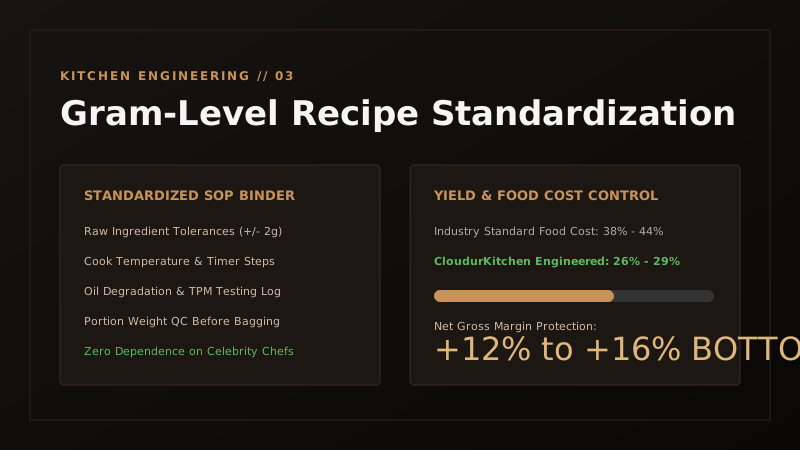
Chef dependency is the single biggest failure point for expanding food businesses. Learn how strict gram-level SOP binders and yield calculators lock food cost between 26% and 29%.
The Peril of "Taste As You Cook" Kitchens
In traditional unorganized restaurants, kitchen consistency depends entirely on the mood and memory of the head cook. When that cook leaves or falls sick, taste varies, customer ratings drop on Swiggy and Zomato, and ingredient wastage spirals out of control.
1. Gram-Level Precision Formulation
At CloudurKitchen, every recipe is documented with calibrated digital scales down to the single gram:
Pre-Portioned Spice Packs: Master spice blends are sealed in standardized batches, eliminating on-the-line measuring errors during peak rushes.
Yield Auditing: Recording raw weight versus cooked weight accounts for moisture loss, giving investors transparent true portion costing.
Kitchen Sticky Notes: Step-by-step pictorial workflow boards mounted above prep lines guide junior kitchen staff to reproduce identical dishes consistently from day one.
"If a dish cannot be cooked identically by two different cooks on opposite shifts, it is not ready for commercial rollout."
2. Total Polar Material (TPM) Oil Management
Deep frying oil is one of the highest consumable line items in fast-casual kitchens. By utilizing digital TPM sensors rather than subjective visual checks, operators avoid premature oil dumping while ensuring compliance with FSSAI health limits.
CapEx & ROI
By Financial Advisory DeskFebruary 12, 20267 min read
Dark Kitchen vs Traditional Dine-In: A 5-Year Capital Expenditure Audit
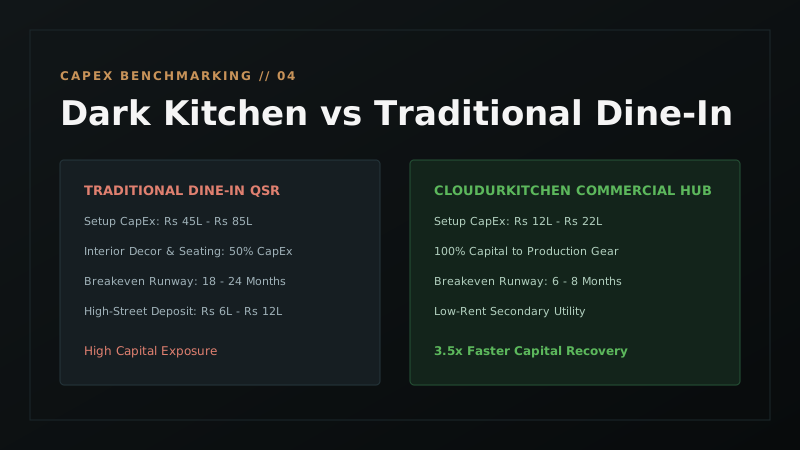
An itemized side-by-side financial comparison comparing an ₹85 Lakh high-street QSR fit-out against an ₹18 Lakh commercial cloud kitchen facility across breakeven runway and IRR.
Where Food Venture Capital Truly Goes
When an entrepreneur budgets ₹50 Lakhs to ₹80 Lakhs to open a traditional retail restaurant, more than 55% of that capital vanishes into non-recoverable architectural fit-outs: fancy false ceilings, premium flooring, custom decorative lighting, sound systems, and hefty commercial landlord security deposits.
1. CapEx Allocation Comparison
Traditional Dine-In: ₹60,000 – ₹90,000 per sq.ft. setup cost. Over half is sunk into aesthetic front-of-house elements that depreciate immediately.
CloudurKitchen Commercial Hub: ₹18,000 – ₹25,000 per sq.ft. setup cost. 90% of all capital is invested in commercial-grade stainless steel fabrication, refrigeration, extraction hoods, and automated cooking ranges that retain tangible resale value.
"A cloud kitchen turns real estate from an expensive vanity billboard into an optimized culinary production factory."
2. Runway to Cash Flow Breakeven
Because fixed monthly overhead (rent, HVAC, service staff) is dramatically reduced, an engineered multi-brand cloud kitchen can achieve cash-flow breakeven within 6 to 8 months, compared to the industry standard 18 to 24 months for sit-down restaurants.
Spatial Engineering
By Operations Engineering TeamJanuary 29, 20266 min read
Multi-Brand Delivery Hubs: Running 6 Virtual Brands from 350 Sq.Ft.
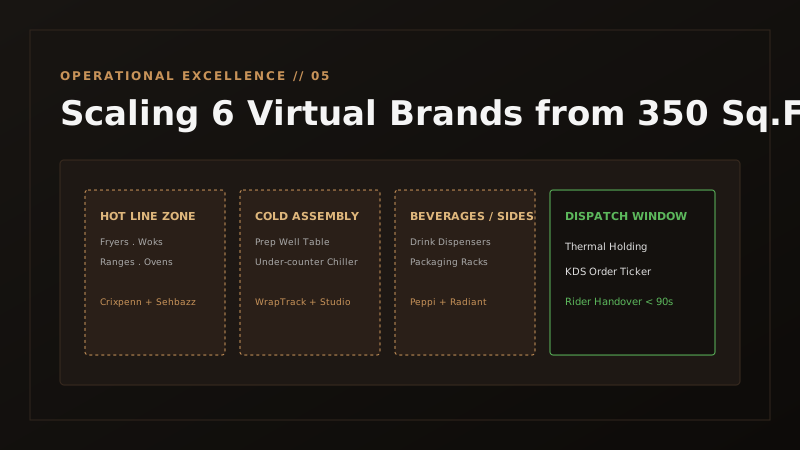
Spatial segregation is the key to preventing operational gridlock. How to cluster hot fryers, cold assembly stations, beverage taps, and rider dispatch into an ergonomic 350 sq.ft. workflow.
Solving the Kitchen Cross-Traffic Bottleneck
The most common failure in amateur multi-brand setups is physical chaos: line cooks bumping into each other, delivery riders walking into hot preparation zones, and orders getting mixed up during the packaging rush.
1. The 4-Zone Spatial Blueprint
In our AutoCAD spatial designs, every square foot is assigned to a unidirectional workflow:
Zone A (Hot Line): Heavy thermal equipment (fryers, wok ranges, tandoors) clustered under a high-velocity exhaust hood with integrated fresh air makeup.
Zone B (Cold Assembly & Prep): Refrigerated prep counters with ingredient wells, ensuring items like wraps, burgers, and salads are assembled at safe food holding temperatures.
Zone C (Consolidated Pantry): Dry goods and packaging materials stacked vertically to exploit ceiling height.
Zone D (Dedicated Rider Dispatch Window): A physical boundary separating the kitchen line from external delivery riders, equipped with heated thermal holding shelves and order ticketing displays.
"Ergonomic kitchen layout is not about having more space — it is about zero wasted footsteps between prep and dispatch."
2. Rapid Rider Handover Protocol
By utilizing multi-tier thermal lockers and clear barcode bag seals, order handover to Zomato and Swiggy delivery partners takes less than 75 seconds from arrival to departure.
...
2. Change comments to BLOG POST 06 START / END
3. Update: Title, Date, Read-Time, Image, Excerpt, and Paragraphs
4. Save blog.html via cPanel File Manager.
============================================================ -->
Article
Article Title
Author · Date · Read Time
COMMUNITY & INDUSTRY VOICES
Submit an Article or Pitch Your Food Venture Story
Are you an F&B founder, culinary innovator, or dark kitchen operator? Share your real-world insights, unit economics, or scaling lessons with our network.
✓
Submission Received
Thank you for submitting your blog. Your submission has been received and is currently under approval. We will review it before publishing.
Consultation & Setup Planning
Ready to Turn Blueprints into a Profitable Kitchen?
Book a commercial spatial and unit economics consultation before committing capital or signing property leases.
 Unit Economics